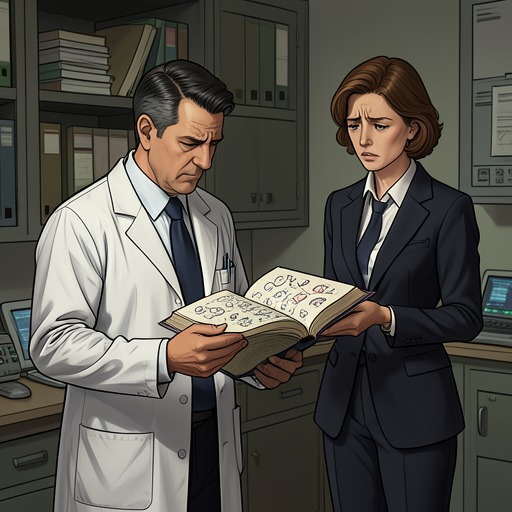
MAOA Knockout testing of the Barber family
Defending JacobThe MAOA Knockout testing of the Barber family begins as a defense investigation into a possible biological predisposition and becomes a test of what a family can bear to know about itself. Andrew Barber seeks a sample from his estranged father, William “Billy” Barber, so that the family’s genetic results can be compared. When Laurie later learns in court that Billy, Andrew, and Jacob Barber all have the mutation, the finding does not prove that Jacob committed murder or that the mutation made him violent; it gives Laurie’s fear of inherited violence a concrete, three-generation shape.
Purpose and Family Background
The test belongs to the defense effort to investigate whether the MAOA Knockout mutation might contribute to aggression under certain environmental conditions. Andrew explains the proposed link to Billy as a possible biological predisposition, not a direct explanation of behavior. The question is therefore broader than Jacob’s case: if the mutation appears in successive generations, what can that pattern tell the family about risk, inheritance, and responsibility?
The request also brings Andrew back into contact with a father he has long kept at a distance. Billy offers help because Jacob is his grandson, but Andrew has already decided not to put him on the witness stand, judging him a poor liar. The genetic sample gives Billy a way to assist the defense without becoming a trial witness, while placing Andrew in the difficult position of asking a prisoner and estranged parent for bodily evidence.
Collecting Billy’s Sample
Andrew arrives with a sterile swab and a plastic envelope, then tells Billy that he needs a DNA sample to test for MAOA Knockout. Billy asks what the mutation is; Andrew describes it as a genetic change that researchers think may code the body to be more aggressive in certain environments. Billy’s blunt questions and Andrew’s explanation turn an abstract theory into a practical request: the defense needs Billy’s DNA to investigate whether the mutation runs through the Barber family.
The collection is constrained by prison rules. At Northern Correctional Institution, Andrew cannot personally swab Billy’s mouth. That would have provided the cleanest chain of custody, since Andrew could testify that the swab had remained in his possession, but the prison’s no-contact restriction bars it. After negotiating with staff and speaking to the deputy warden, Andrew is permitted to pass the kit through a guard instead.
From the visiting booth, Andrew talks Billy through each step. Billy must open the package, swallow, rub the long cotton swab along the inside of his cheek near the back of his mouth, place it in the plastic container without touching the tip to anything else, seal it, and sign and date the label. Andrew must watch throughout so Billy does not block his view. With his hands still cuffed, Billy tears open the paper wrapper, first puts the swab in his mouth like a lollipop and pretends to bite it, then wipes it against his upper gums and inside his cheek. He holds the stick up to the window. The sample is obtained, but the elaborate instructions make clear how much the test depends on preserving the identity and handling of one small object.
The Result in Court
The test’s significance sharpens when Laurie questions Dr. Vogel during Jacob’s trial. She asks whether Jacob has the mutation and presses for a direct answer rather than another explanation of predisposition. Dr. Vogel says yes. Laurie then asks whether Andrew has it and whether her father-in-law has it. Dr. Vogel answers yes to both: the mutation is present in Jacob, Andrew, and Billy.
The sequence converts a qualified scientific idea into a visible family pattern. The result does not, by itself, establish that any of the three has acted violently because of the mutation, nor does it resolve Jacob’s guilt. But the repeated affirmative answers give Laurie’s fear a form that is difficult to dismiss as merely theoretical. Her questions connect the accused son, the husband beside her, and the grandfather whose DNA Andrew went to prison to collect.
Consequences for Andrew and Laurie
The results land within a marriage already strained by the trial and by disagreement over how to understand Jacob’s childhood. Laurie recalls their early parenting as a period in which they may have been unprepared and made mistakes; Andrew resists the implication that they caused Jacob’s present crisis. As they sit together, Laurie’s hand briefly rests on her chair arm, but she withdraws it before Andrew can reach for it. The gesture makes their disagreement physical: comfort is considered, then refused.
In court, Laurie sits alone on the front bench, separated from the other people around her by an empty space. She has refused Andrew’s offer to enlist her parents to sit with her, and he understands her solitude as a way of bearing the cost of marrying into his family. The night before Dr. Vogel’s testimony, the diagnosis leaves Laurie so shaken that she asks for one of Andrew’s sleeping pills and still cannot sleep. When he tries to comfort her in bed, she moves away to the far edge. The gene’s disclosure therefore intensifies not only her fear about Jacob but also the distance between the parents trying to decide what that fear requires of them.
Laurie later asks Andrew what they should do if Jacob is acquitted and then kills again, insisting that they may have some responsibility. Andrew tells her that she is exhausted and should stop thinking that way, postponing the discussion rather than answering it. Her question remains open: a genetic result offers neither a verdict nor instructions for a family, yet it makes the prospect of future harm part of their present moral argument.
Significance and Limits
The testing’s power lies in the gap between what the result establishes and what the family wants it to explain. It establishes that the mutation is shared by three generations of Barber men. It does not establish that the mutation is a “murder gene,” determine Jacob’s guilt, or settle whether his parents could have prevented what happened. Andrew’s earlier explanation emphasizes predisposition and environment; Laurie’s courtroom questions, by contrast, gather the positive results into a pattern of inheritance that feels like an answer even when it is not a causal proof.
That tension makes the test more consequential than a laboratory inquiry. Andrew seeks genetic information as part of Jacob’s defense, but the evidence returns to the family as a source of uncertainty and dread. The sample collected through a prison window and the three yeses in court link a practical investigation to the intimate question that the trial cannot resolve for Laurie: whether the danger she fears is already written into the family, and what responsibility follows from knowing that possibility exists.